
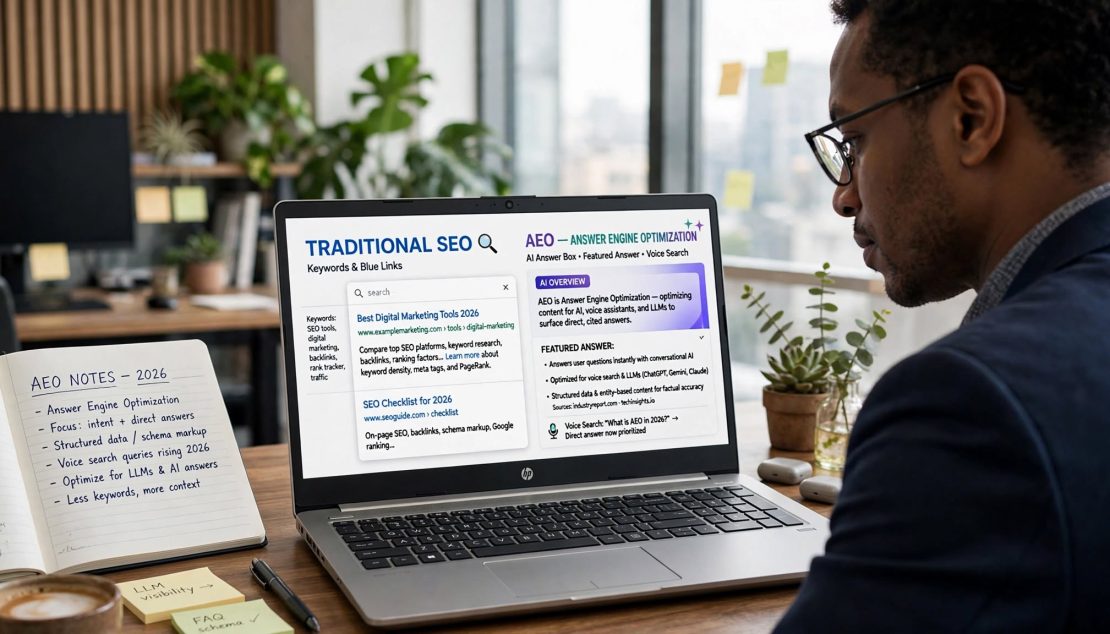

We all used to go on search engines like Google, DuckDuckGo, Bing and others. Whenever we searched, we would look through the blue links and click one. That was the era of traditional SEO.
- We all used to go on search engines like Google, DuckDuckGo, Bing and others.
- Whenever we searched, we would look through the blue links and click one.
- You want to be one of the sources the system trusts enough to name or quote.
- Mobile-first behaviour and rising access to ChatGPT, Gemini and similar platforms mean many research journeys now start inside AI interface...
Keep reading for the full breakdown on AEO vs SEO — everything you need to know is covered below.
Today, you type a question inside Google or ChatGPT and you get a complete answer at the top of the screen. No need to open ten blue links. The information is already there, ready-made, often with few source names attached. That shift is already changing how people find businesses, services and advice.
Traditional search engine optimization still matters. But it is no longer enough on its own. Answer Engine Optimization, AEO, has become the layer that decides whether your brand shows up inside those generated answers or disappears from view.
What is AEO?
Answer Engine Optimization (AEO) is the practice of structuring your content, brand signals and technical setup so that AI systems like Google AI Overviews, ChatGPT, Perplexity, Gemini, Claude and similar tools will cite or recommend your brand when they generate a direct answer. Unlike SEO which aims for page rankings and clicks, AEO aims for inclusion inside the answer itself.
How AI Systems Now Answer Queries
Google’s AI Overviews now sit above traditional results for many searches. They pull information from multiple sources and present a short, synthesized summary and most users stop there.
AI Mode takes the experience further. It turns the search into a conversation. Follow-up questions stay inside Google’s interface, and the system continues generating answers without sending people to external sites.
ChatGPT, when its search feature is active, produces a written reply and lists sources it used. Perplexity works in similar way but makes the citations more prominent. Gemini draws heavily on Google’s index and knowledge graph. Claude and other models follow their own retrieval patterns.
In each case, the goal for user is same: get a usable answer quickly. The goal for a brand is different. You want to be one of the sources the system trusts enough to name or quote.
Key Differences Between SEO and AEO
SEO and AEO share many technical foundations like crawlable pages, clear structure, authority signals, but they optimise for different outcomes.
Traditional SEO: The primary goal of SEO is to rank pages in search results. Success measure is rankings, clicks, organic traffic. Main surfaces are Google and Bing results pages. Content style that wins is comprehensive pages with topical depth. Key extra signals are backlinks and technical performance.
Answer Engine Optimization (AEO): For AEO, its primary goal is to be cited or named inside AI-generated answers. Success measure is mentions, citations, share of voice in answers. Main surfaces are AI Overviews, ChatGPT, Perplexity, Gemini, Claude. Content style that wins is clear, self-contained answers and structured blocks. Key extra signals are entity clarity, consistent brand facts, and extractable passages.
A page can rank well and still never appear inside AI answer. The model may prefer a cleaner, more direct source or a third-party site that already has stronger entity signals.
Why Zero-Click Searches Keep Rising
More searches now end without anyone leaving the results page or chat interface. Recent data puts zero-click rate on Google in United States at around 68 percent in early 2026, up from roughly 60 percent two years earlier.
AI Overviews play clear role. When they appear, click-through rates on organic results drop sharply, often by 50 percent or more. AI Mode shows even higher rates of users staying inside the platform.
People still search but they simply resolve more of their questions without visiting websites. Brands that only track traditional organic traffic therefore see numbers fall even when their content remains relevant.
What This Means for Nigerian Businesses and Professionals
Nigerian users are adopting AI search tools at notable pace. Mobile-first behaviour and rising access to ChatGPT, Gemini and similar platforms mean many research journeys now start inside AI interface rather than classic search results page.
Local content has real opening. Global models still lean heavily on international sources for many African and Nigerian topics. Clear, well-structured pages about business registration, tax processes, professional services, local regulations or industry practices can become preferred references simply because stronger local alternatives are scarce.
Professionals and companies that continue to treat SEO as only visibility channel risk becoming invisible in exact places where recommendations and shortlists are now formed. Those that combine solid technical SEO with AEO practices stand better chance of being named when someone asks AI tool for best options in Lagos, Abuja or across Nigeria.
Common Mistakes
- Treating AEO as complete replacement for SEO instead of additional layer.
- Publishing long, introductory content that never delivers direct, extractable answer near top.
- Ignoring entity consistency. Different versions of your brand name, address or service descriptions across web confuse models.
- Measuring only classic organic traffic and missing citation share inside AI answers.
- Copying generic global content instead of creating clear, locally grounded explanations.
Expert Tips You Should Implement
Write first 40 to 60 words of important pages as self-contained answer to main question the page targets. Models favour passages they can lift cleanly.
Use clear headings that match real questions people ask. Follow each heading with short, direct paragraph before expanding.
Keep brand facts consistent everywhere – website, directories, social profiles, press mentions. Models rely on that consistency to decide whether your entity is trustworthy.
Monitor small set of high-value questions in ChatGPT, Perplexity and Google AI Overviews regularly. Track whether you appear, how you are described, and which competitors are cited instead.
Prioritize topics where local expertise is still thin in training and retrieval data of major models. Those gaps remain open longer in markets like Nigeria.
Frequently Asked Questions
What does AEO stand for?
Answer Engine Optimisation. It is the work of making your content and brand easy for AI systems to select and cite when they generate answers.
Is AEO same as GEO?
The terms overlap heavily. Some people use AEO for answer surfaces in general and GEO for generative AI outputs specifically. In practice most teams treat them as closely related efforts.
Does traditional SEO still matter?
Yes. Strong technical foundations, crawlability and authority still help AI systems discover and trust your content. SEO alone is no longer sufficient for full visibility.
How do I know if my content is being cited?
Test important queries directly in ChatGPT, Perplexity, Gemini and Google AI Overviews. Look for your brand name or link to your pages inside generated answers. Some specialised tools also track citation frequency.
Can small Nigerian businesses compete with large international sites?
Yes, especially on local and regional topics. Clear, accurate, well-structured content about Nigerian processes and services often outperforms generic global pages for those queries.
What content formats work best for AEO?
Direct definitions, numbered steps, comparison tables, concise FAQ blocks and short evidence-backed statements that can stand alone.
Will AEO replace need for website?
No. Citations still point back to sources. Strong website remains place where deeper engagement and conversion happen once someone decides to click.
How long does it take to see results from AEO work?
Some structural improvements can influence answers within weeks. Building consistent entity recognition and third-party signals usually takes longer, often several months of steady effort.
Should I block AI crawlers?
Only if you have deliberate reason. Most businesses benefit from allowing major AI systems to access public content so they can cite it.
What is biggest risk of ignoring AEO?
Becoming invisible in interfaces where many users now form their shortlists and first impressions, even if your classic search rankings remain healthy.
Leave a Reply